


Dec 11 2012
Future of the Real Estate Market in the US
The Future of the Housing Market Looks Good
Of course, we can’t tell you exactly what the future of the real estate market holds. If it could be predicted in detail, there may have never been a housing bubble burst or economic downturn. At least the results would have been limited to extreme risk takers. Mortgages that stretched finances would not have seemed like such a good investment and subprime mortgages might not have ever caught on. But at some level, it was a lack of looking to the future that led to these problems. And without some foresight, we would be blind to opportunity and risk making similarly bad decisions.
So here we would like to show the current status of the real estate market and what it means in the near future. The housing market is on the upswing. There are a lot of reasons for confidence, and always a few that remind us to be guarded. Below, we detail some of the indicators that show now is a good time to think again about buying or selling a home.
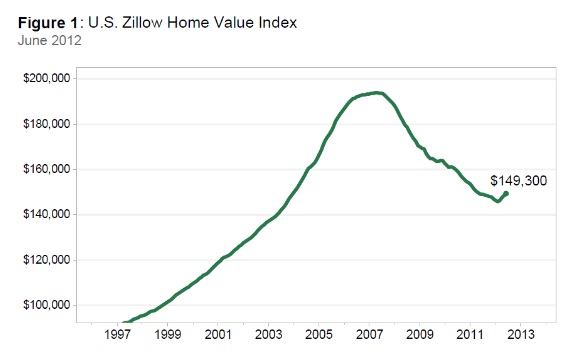
Growth has taken hold
July 2011 was the second worst month in total home sales since the economic downturn began. Since then, the housing market has seen stable growth, with sales slowly increasing without the major peaks and troughs that defined 2009-2011. With numbers just released for October, two indicators used by the National Association of Realtors show a lot of reason for confidence.
Pending home sales—which tracks how many homes were under contract for the month—increased by 5.2% over September and is 13% higher than October 2011. Existing-home sales—which reflects completed transactions—rose 2.1% over September and 10.9% from a year ago. The average home price for October was also 11% higher than it was a year ago, and each of the last eight months have seen increases over the previous year. That hasn’t happened since 2006.
In short, the housing market seems to be more stable than it has been in years, with prices slowly increasing.
Low Interest Rates
Interest rates are still decreasing. Three years ago, in November 2009, a 30 year fixed mortgage interest rate hovered around 5%. Six months ago the rate was considered low at 3.78%. Today it is 3.40%. Similarly, a 15 year fixed mortgage currently carries an interest rate of 2.84% when 6 months ago it was 3.08%. We can say that mortgage rates are at a historic low without using hyperbole: Time magazine said interest rates are so low “Even the founding fathers would gawk.” For a look at the last 10+ years of interest rates, see here.
Low interest rates make buying a house much more desirable. The difference over the course of a 30 year mortgage (using a $250,000 loan amount) between today’s 3.40% rate and the rate 6 months ago leads to a $19,000 savings. Compared to the rate 3 years ago? $84,000 in savings over the life of the mortgage. Lenders are still being very strict with their lending, however, and getting a loan is not as easy as it once was. If you qualify and you have a goal to buy a house, now is a great time.
The Economy
The economy and the housing market dual each other in somewhat of a vicious or virtuous cycle. While the economy is bad and prospects uncertain, people are understandably wary of investing in a house. But the economy will not be strong while the housing market is in the dumps. It is hard to say which causes the other’s difficulty—or success. We know the housing market is slowly getting better, what about the economy?
There are good signs: in the 3rd Quarter of 2012, the economy grew at a better-than-expected 2.7%. The unemployment rate in September hit the lowest rate (7.8%) since December 2008. (The high was October 2009 when it cracked 10%). Bad signs include that better-but-still-high unemployment rate and the big worry of Washington and the fiscal cliff, in which automatic government spending cuts will kick in if Congress does not reach a deal. Some experts believe the cuts will have a negative effect on the economy.
Inventory
Inventory—the number of houses on the market—is at its lowest level since 2002. This tips the balance of supply and demand: because there is not much supply, there is more competition for houses on the market and prices are likely to rise.
Another factor is set to work with low inventory to increase prices: the number of households is up. This may seem obvious because our population is constantly growing. However, in the aftermath of the economic downturn, the number of households actually fell as more families moved in together or didn’t move out on their own when their cohorts a few years older would have. That number is now growing again, meaning there is a bigger market for housing sales.
Confidence
There is something to be said for the role of psychology in the housing market. Confidence is a big deal. It may seem like low prices would lead to more sales and higher prices would scare off buyers. However, because houses are such a big investment, buyers often see rising prices as a good thing. For one, they get the idea that the house will not continue to lose value after they buy it. Additionally, they want to be on the lower end of a rise in value—they want to buy while interest rates are still low but before other factors lead to dramatic price increases. So the fact that prices are increasing may actually fuel a better housing market.
In short, we cannot say for sure what the future holds for the housing market in the US or in St. George. But after a few tough years, a combination of factors—from increasing prices and low inventory, to low interest rates and growing confidence—the future is looking up in the housing market.
Comments Off